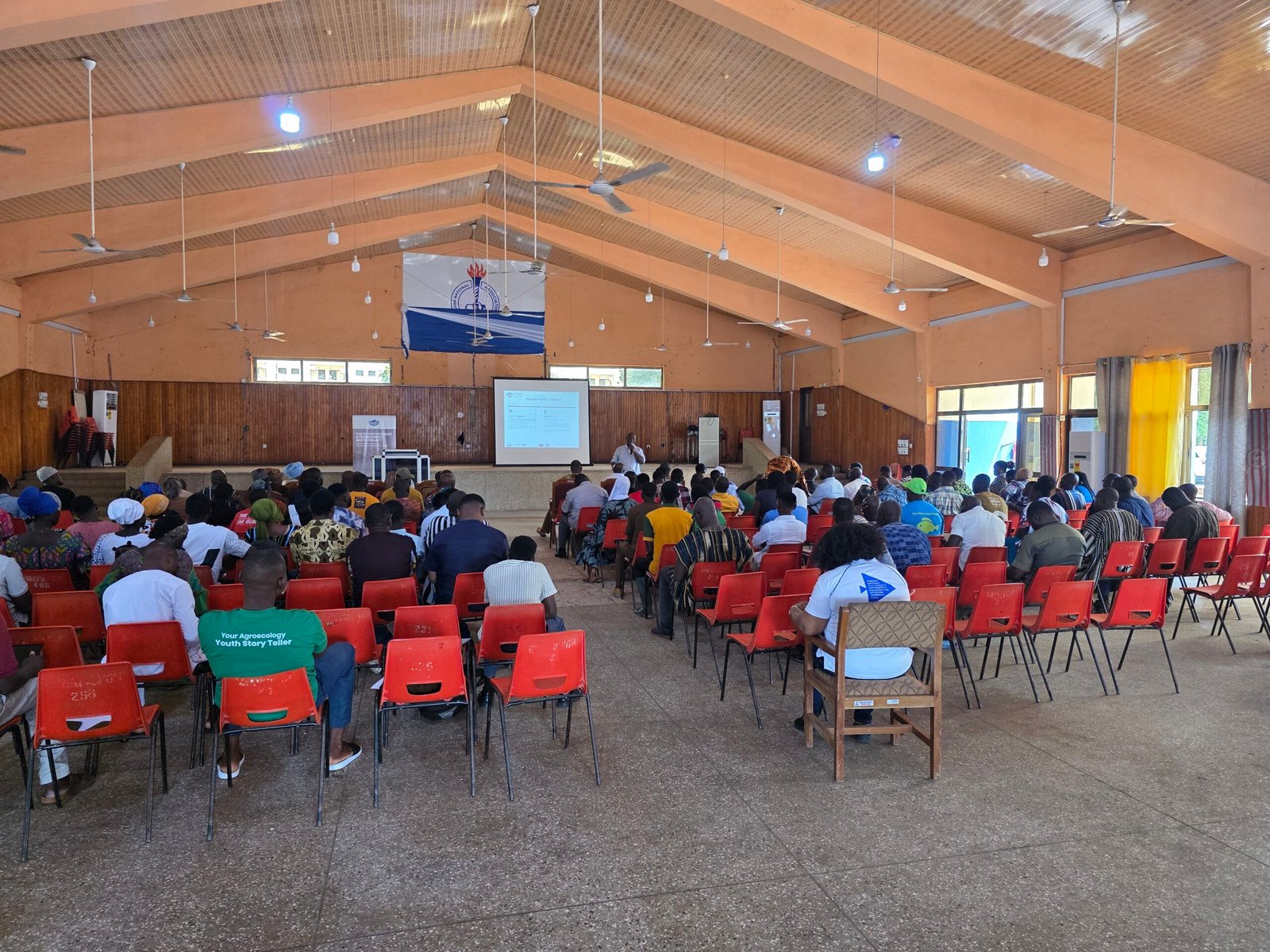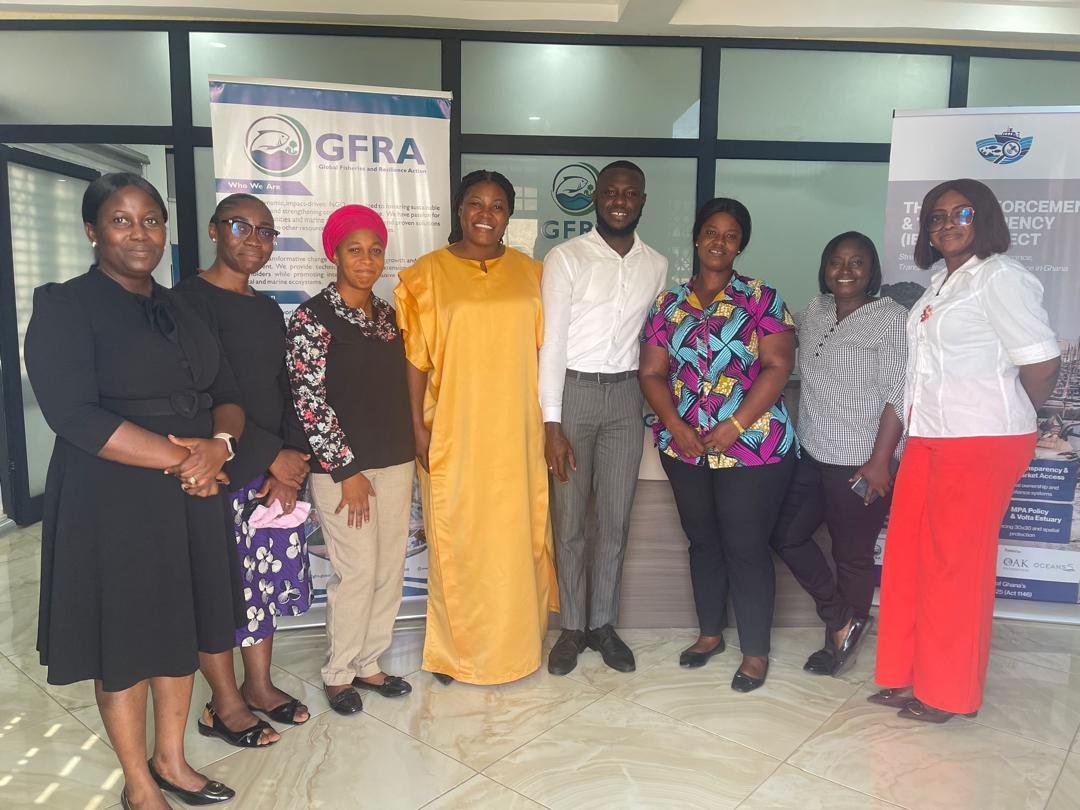
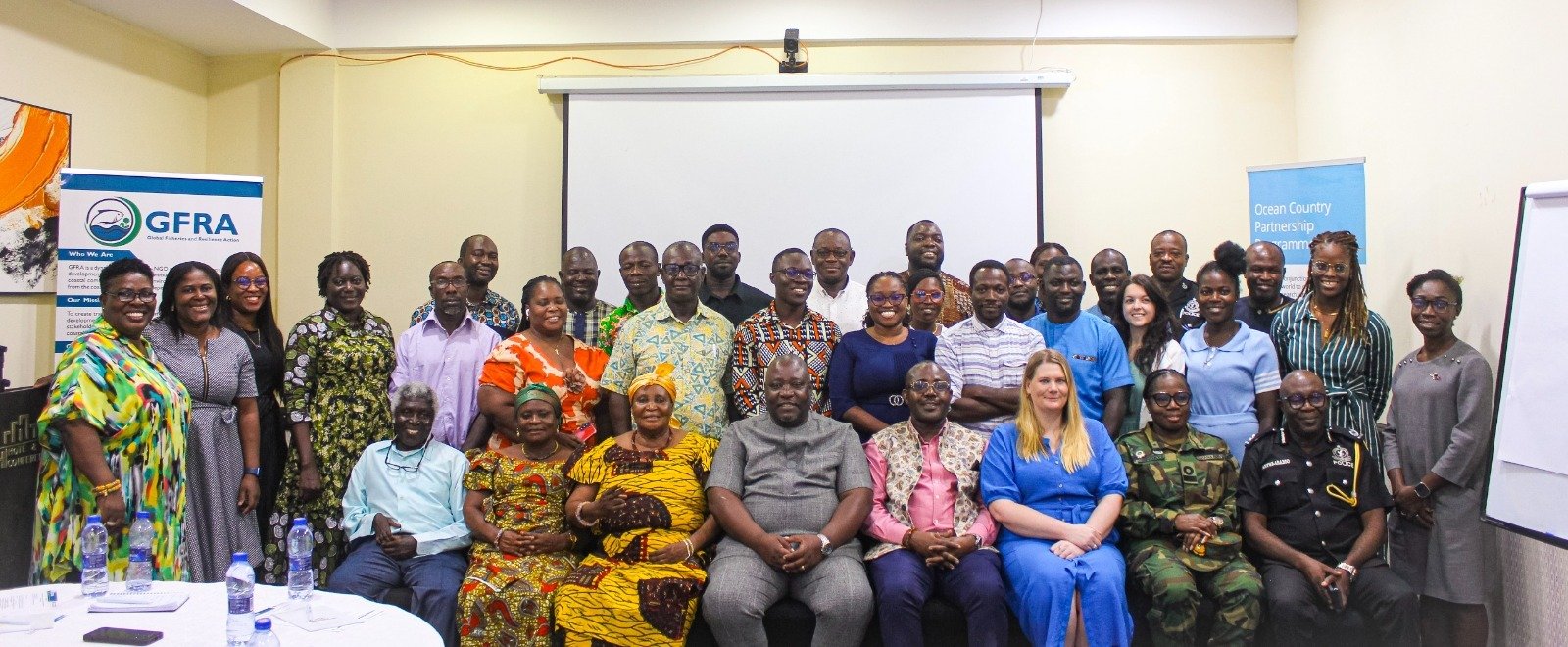
The GFRA LBG, in collaboration with the Ocean Country Partnership Programme (OCPP) of the United Kingdom International Development, convened a one-day workshop titled “Strengthening Ghana’s Marine Protected Area Implementation Through Lessons and Transition Planning” at the AH Hotel, in Accra, Ghana, on 10 February 2026, to conduct a national learning exercise, reflecting on lessons from the three years of partnership in ocean governance, and MPA implementation.
The meeting’s participants included representatives from (CAOPA), Environmental Protection Agency (EPA), Fisheries Commission, (GFD), Ghana Industrial Trawlers Association (GITA), Hen Mpoano, Land Use and Spatial Planning Authority (LUSPA), Ghana National Canoe Fisherman Council (GNCFC), Marine Police, Management Executive Committee (MEC), National Fisheries Association of Ghana (NAFAG), National Small Pelagic Comanagement Committee (NSPCC), Odo Circle of Support, the University of Cape Coast, University of Ghana
In opening remarks, a Representative of the British High Commission to Ghana noted that the event was being held to provide an opportunity to reflect on the collaboration between Ghana and the United Kingdom under the OCPP, and the progress toward the gazettement of the Cape Three Points Marine Protected Area. She commended Ghanaian institutions for the strong leadership, commitment and collaboration demonstrated throughout the implementation of the programme through the UK Blue Planet Fund over the past three years, noting that this had been critical to the progress achieved at both the technical and policy levels. Although the current phase of the programme is expected to conclude in March, she reaffirmed the United Kingdom’s continued commitment to supporting ocean governance and the sustainable blue economy in Ghana.
In his keynote address delivered on behalf of the Hon. Minister of Fisheries and Aquaculture (MOFA), Mr Ishamel Browne, Director of Research, Statistics, and Information Management (RSIM) at MOFA, drew attention to the timeliness of the workshop being held after the selection of Cape Three Points as Ghana’s first MPA, and in the context of increasing resource and management challenges. He expressed delight that the extensive stakeholder consultations and community engagements to build understanding, acceptance and local ownership was appropriately reflected in the diverse composition of the meeting’s participants. He expressed confidence that, through continuous engagement, strong partnerships and coordinated efforts, the MPA initiative would achieve its intended ecological and socio-economic benefits.
Hen Mpoano’s Stephen Kankam, delivered the first presentation of the day, taking participants through Ghana’s MPA journey, and key activities under the OCPP Beyond MPA Designation Project. An MPA Roadmap Framework to Support the implementation of MPAs in Ghana and other key outputs were developed under that project. There have been a number of outcomes related to the Greater Cape Three Points MPA: the establishment of a non-state actors platform for MPA-related concerns, expectations and recommendations to be openly expressed; and a Communication, Engagement and Outreach Strategy has been developed and is being implemented to build national and community-level understanding, support and ownership for the implementation of the Greater Cape Three Points MPA.
Julia Baker, OCPP Programme Director, and Stephanie Clarkson, OCPP Senior MPA Specialist delivered a presentation on the OCPP, workstreams undertaken in Ghana, reflections on the lessons learned, challenges encountered, and considerations for sustaining progress following OCPP exit. OCPP’s work streams in Ghana include activity in themes from marine pollution, sustainable seafood (aquaculture and capture fisheries), to marine biodiversity. The OCPP has been supporting MPA activity in Ghana since 2023 when scoping exercises were conducted and an MPA Schematic and Donor Activity Matrix were developed. The challenges encountered included a complex and crowded funding landscape, and coordination fatigue. Adaptive project planning, strong cross-government coordination to align national, regional and district priorities, and the establishment of clear priority work areas were some of the key lessons learnt. Suggestions to sustain MPA progress, included securing predictable multi-year funding streams and streamlining procedures to enhance operational efficiency and delivery.
Richard Paniel delivered a presentation on regional practices and experience in MPA, beginning with Cote d’Ivoire’s MPA journey and the evolving institutional arrangements for MPA establishment and management. The key takeaway is that administrative and management structures for MPAs must be defined, mandated and resourced before site designation if progress is to be coherent. An analysis of the example of Congo (which started its MPA process with marine spatial planning) demonstrated that socio-economic conflicts were minimized, MPA expansion could be phased, and data generated could be used to balance objectives in multiple sectors. Another key lesson was to ensure that legal reforms for MPA establishment, management authority and enforcement powers happen in parallel with spatial planning to forestall limited enforcement powers for MPA authorities, unclear definitions of MPAs and lack of legal recognition.
Representatives from Oceana jointly delivered a presentation on international experience in community-based and low-cost monitoring and enforcement, highlighting practical strategies for achieving effective MPA compliance in contexts with limited financial and operational capacity. Country case studies on Canada, Chile and Mexico all confirmed that effective monitoring and enforcement are based on transparency in decision-making, community participation and co-management, clear communication of socio-economic benefits, and accessible and credible scientific evidence. Participants were taken through the experience of the Philippines and the use of publicly accessible satellite-based data and open digital platforms to monitor fishing activity and support enforcement in near real time. The experience showed that open access improves transparency, accountability and detection of illegal fishing even with limited patrol assets. Moreover, visual tools make complex information accessible to decisionmakers and communities, especially when coupled with early engagement and involvement.
During subsequent plenary session, breakout groups presented their findings on the thematic areas of governance, legal frameworks, enforcement, sustainability, and stakeholder engagement. The groups highlighted lessons learned from both international experiences and regional practices, identifying key gaps and proposing actionable recommendations tailored to the Ghanaian context. Key points raised, included the need for phased implementation of MPAs, the strategic use of marine spatial planning and decision support tools, and the critical role of inclusive stakeholder engagement in securing long-term compliance.
Participants consolidated and validated recommendations which include reviewing and updating legal and policy frameworks to enable enforcement and co-management; securing long-term financial sustainability and building technical capacity; and encouraging early, continuous, and meaningful engagement of local communities and other stakeholders in MPA decision-making and management. The day ended with closing remarks from Deputy Director of the Fisheries Commission, Professor Berchie Asiedu, who called on all stakeholders to work together to ensure that Ghana transitions from MPA gazettement to fully functional, ecologically effective, and socially inclusive marine protected areas.