Ghana’s First Marine Protected Area Marks the Beginning of Its Blue Future
The declaration of the Greater Cape Three Points area as Ghana’s first-ever Marine Protected Area is the culmination of twenty years of effort, opening a new chapter of a much longer story of ocean stewardship.
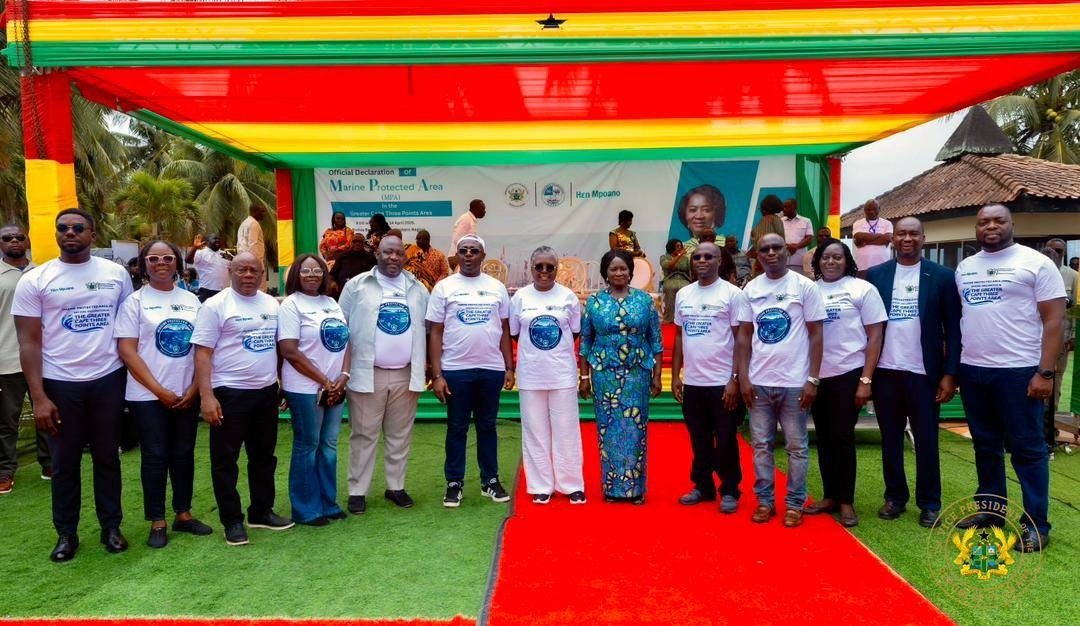
On Tuesday, 14 April 2026, Ghana made history again. At a ceremony held at the Busua Resort in the Western Region, Vice President Her Excellency Professor Naana Jane Opoku-Agyemang declared the Greater Cape Three Points area Ghana’s first-ever Marine Protected Area (MPA), crowing over twenty years of advocacy, scientific work, and community engagement with a formal recognition.
The ceremony was hosted by the Minister for Fisheries and Aquaculture, Hon. Emelia Arthur, and the civil society organisation Hen Mpoano, whose sustained commitment to marine conservation in Ghana’s Western Region has been central to this achievement. Solidarity messages were delivered by Ministers from Environment, Science, and Technology; Tourism, Culture and Creative Arts; Energy and Green Transition; Lands and Natural Resources; and Local Government, Chieftaincy and Religious Affairs, alongside the Western Regional Minister and the President of the Western Regional House of Chiefs. The presence of the President of the National Fisheries Association of Ghana (NAFAG), the President of the National Fish Processors and Traders Association (NAFPTA), and a representative of the African Confederation of Professional Organisations of Artisanal Fisheries (CAOPA) and other fisheries sector stakeholders reflected the breadth of the coalition behind this declaration.
In her opening remarks, Hon. Emelia Arthur called the MPA a collective national triumph and a cornerstone of Ghana’s blue economy vision, stating, “This is not an end, it is a beginning. The beginning of a network. The beginning of restoration. The beginning of a new social contract between people and the sea. Let this be our legacy: that at a critical moment, we chose courage over complacency, stewardship over exploitation, and the future over the present.”
GFRA was represented at the ceremony by Country Director Socrates Segbor, who noted that the declaration represents an important step within a broader national effort to strengthen fisheries management — one that brings together conservation, sustainable use, and effective governance. “It is through this integrated approach,” he said, “that lasting impact will be achieved.”
A Legal Foundation Years in the Making
The Greater Cape Three Points MPA sits within the significant reforms of Ghana’s fisheries governance via the Fisheries and Aquaculture Act, 2025 (Act 1146). Section 39 of the Fisheries and Aquaculture Act, 2025 (Act 1146) strengthens the legal basis for conservation and provides the statutory foundation that makes MPA declarations possible.
Act 1146 also introduces new requirements for transparency in fishing licensing, vessel registries, and beneficial ownership, and expands the Inshore Exclusive Zone from six to twelve nautical miles, reserving a wider belt of coastal waters for artisanal fishers. The MPA declaration and the IEZ expansion together signal a Ghanaian fisheries sector in deliberate, coordinated transformation.
One MPA, and What Must Come Next
The establishment of the Greater Cape Three Points MPA is a beginning, not an end in and of itself. For marine protection to deliver its full ecological benefit — for fish stocks to recover, for spawning grounds to be safeguarded, for the spillover of fish abundance into surrounding fishing areas to materialise — Ghana needs a network of protected areas across its waters, not a single site. Marine ecologists are clear that connectivity between protected areas is what drives population-level recovery for species like the sardinella and anchovy that are central to Ghana’s small pelagic fisheries. A single MPA, however significant, cannot do that work alone.
The creation of the MPA is also part of Ghana meeting its commitment to the Kunming-Montreal Global Biodiversity Framework Target 3 (30% of ocean protected by 2030). The GCTPMPA covers 703.86 km2 and encompasses both marine and nearshore coastal environments within the Western Region, contributing thereby to the national target. Given that Ghana’s total marine area is approximately 237,000 km2, the more MPAs will need to be established to meet the target.
Through the IEZET project, led by GFRA in collaboration with the Environmental Justice Foundation (EJF) and Hen Mpoano, and funded by Oak Foundation and Oceans 5 — GFRA is actively supporting the development of a National Marine Protected Area Policy that would provide the governance framework for a connected network of protected areas across Ghana’s waters. The project is also laying the foundation for a Volta Estuary MPA at Anyanui, which would represent the next step in building that network. The National MPA Policy is not an administrative formality: it is the instrument that will clarify each institution’s mandate, coordinate the efforts of government, civil society, and communities, and enable Ghana to move with coherence and ambition towards its conservation commitments.
The declaration at Busua on 14 April 2026 will be remembered as the moment Ghana’s marine waters finally had a place it designated as protected. The work now is to ensure that this area becomes the first of many.